For working speakers
Find it. Pitch it. Book it.
Get booked without the busywork. Find speaking opportunities, manage your pitch assets, and track your submissions all in one place.
Find it
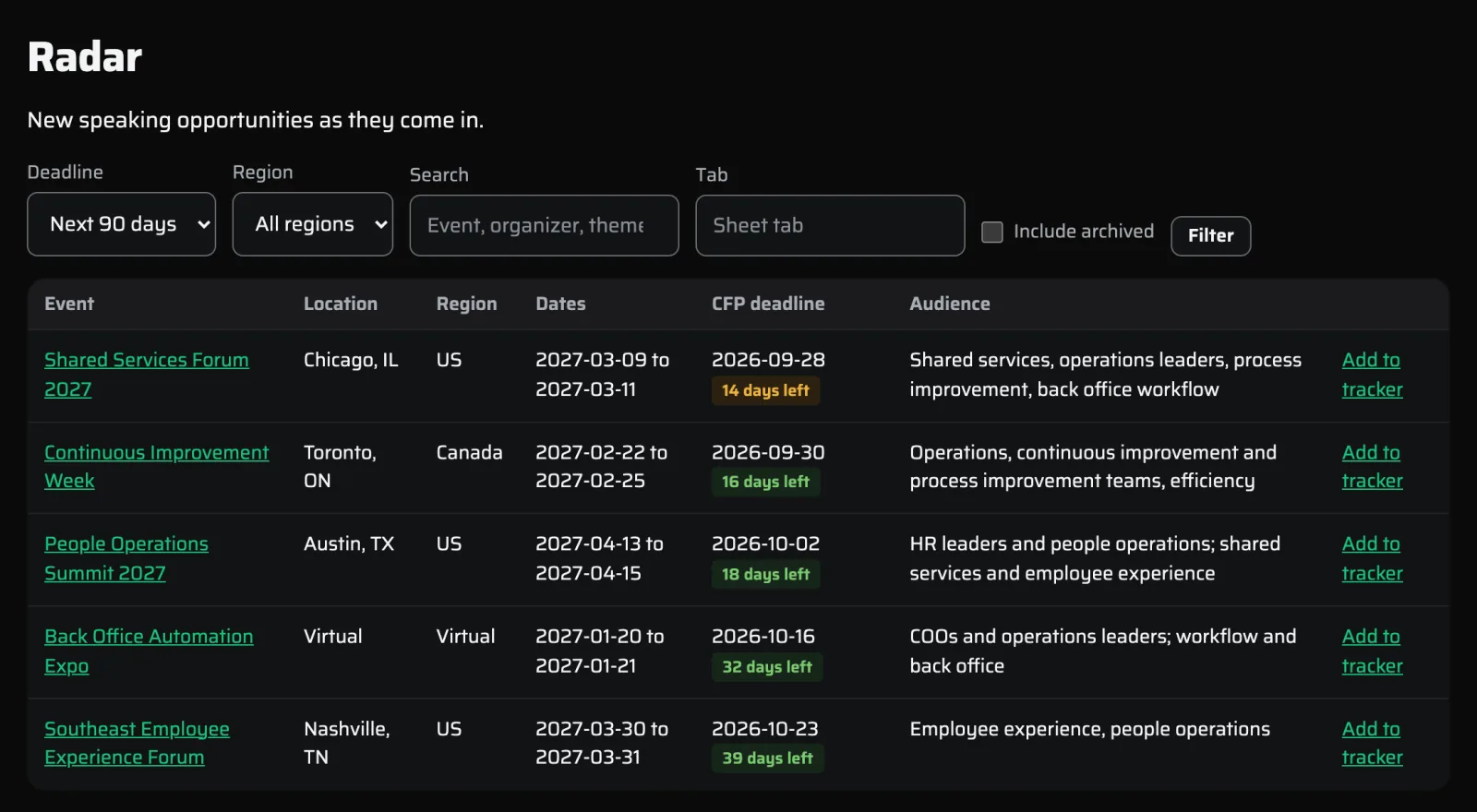
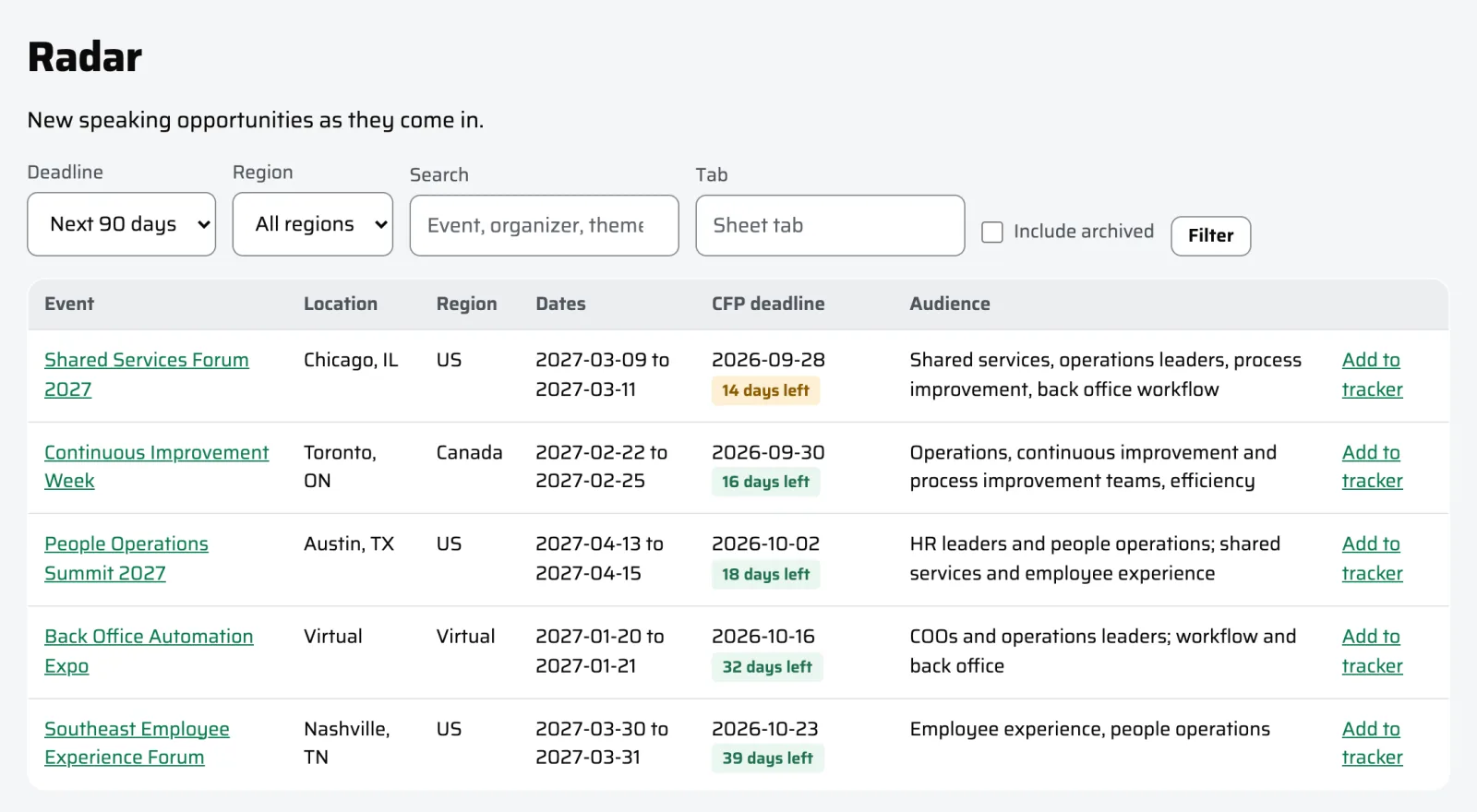
Events and calls for speakers, researched and kept current by 4Spot, then scored against the stages you want.
Pitch it
Your bios, talks, and proof in one place, assembled into a finished application in minutes instead of an afternoon.
Book it
Every submission tracked from suggested to booked, with the deadline flagged while you can still make it.
Another season of stages is being booked right now
You did not get into speaking to keep a spreadsheet. But the events that take outside speakers are scattered across a few hundred association websites, each one opens and closes its call on its own schedule, and none of them tell you when.
So the work piles up in the same places every time:
- Hunting for events that take outside speakers
- Working out whether this one even pays
- A bio at whatever length this one wants
- A session description, rewritten again
- Takeaways, in their format
- AV and travel questions
- Past engagements, retyped
- The deadline, if you find it at all
Miss one deadline and that stage is booked for a year. Miss a season of them and somebody else is on the stage you wanted, telling an audience what you would have told them.
Somebody else does the searching
This is the part that is hard to do alone, so it is the part we do for you. 4Spot researches speaking opportunities and keeps them current, and one shared list serves every member. You are not running your own search. You are reading the results of ours.
Every opportunity on the Radar arrives as a worked record, not a link:
- The event, the organizer, and the website
- Dates, and how firm those dates are
- Where it is, or whether it is virtual
- Roughly how many people attend
- The audience and the theme
- When the call for speakers opens and closes
- The submission link
- The date we last checked all of it
The Matcher scores each new one against your lanes and drops the best into your Tracker, so the ones worth your time come to you.
Write it once. Apply for years.
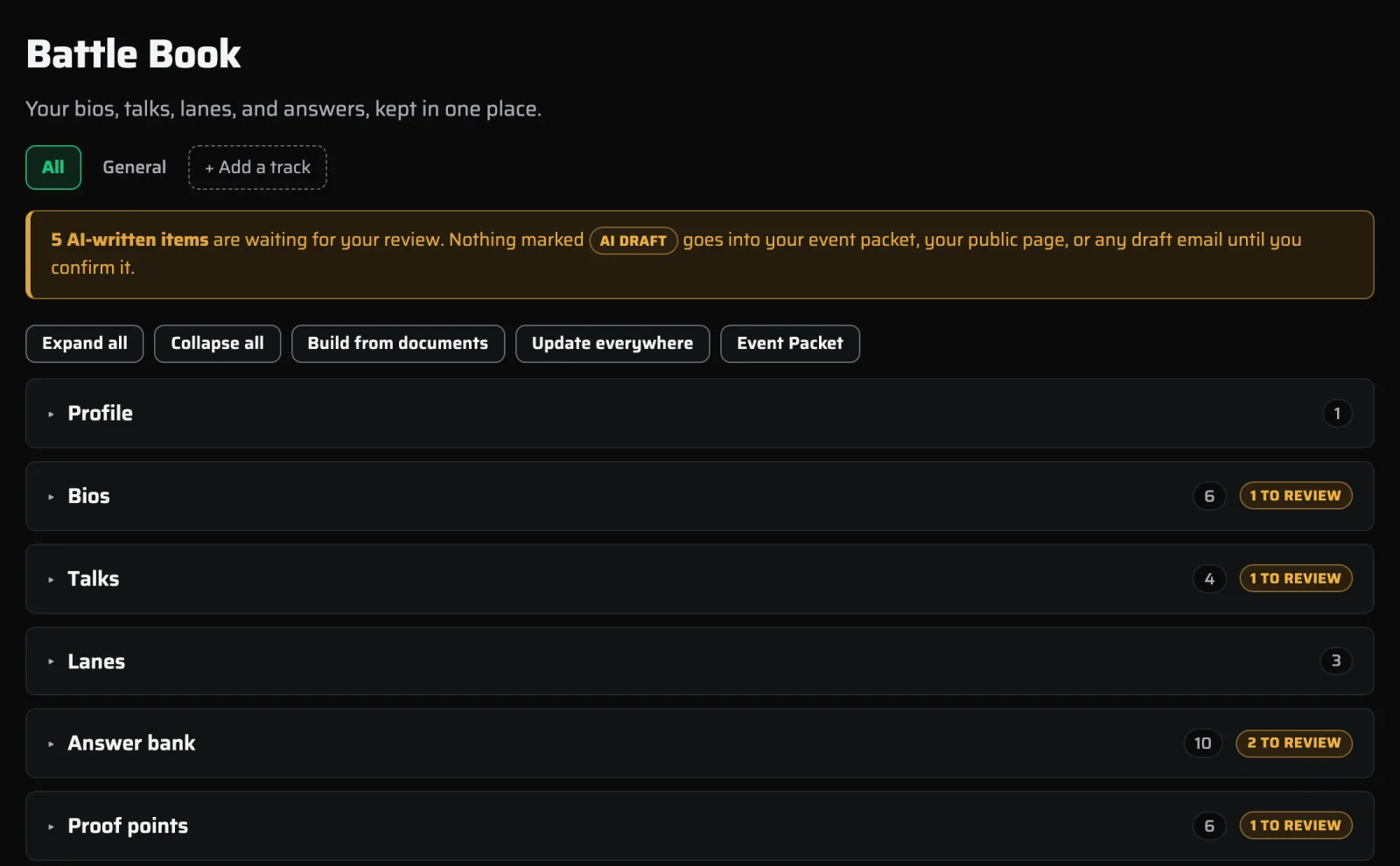
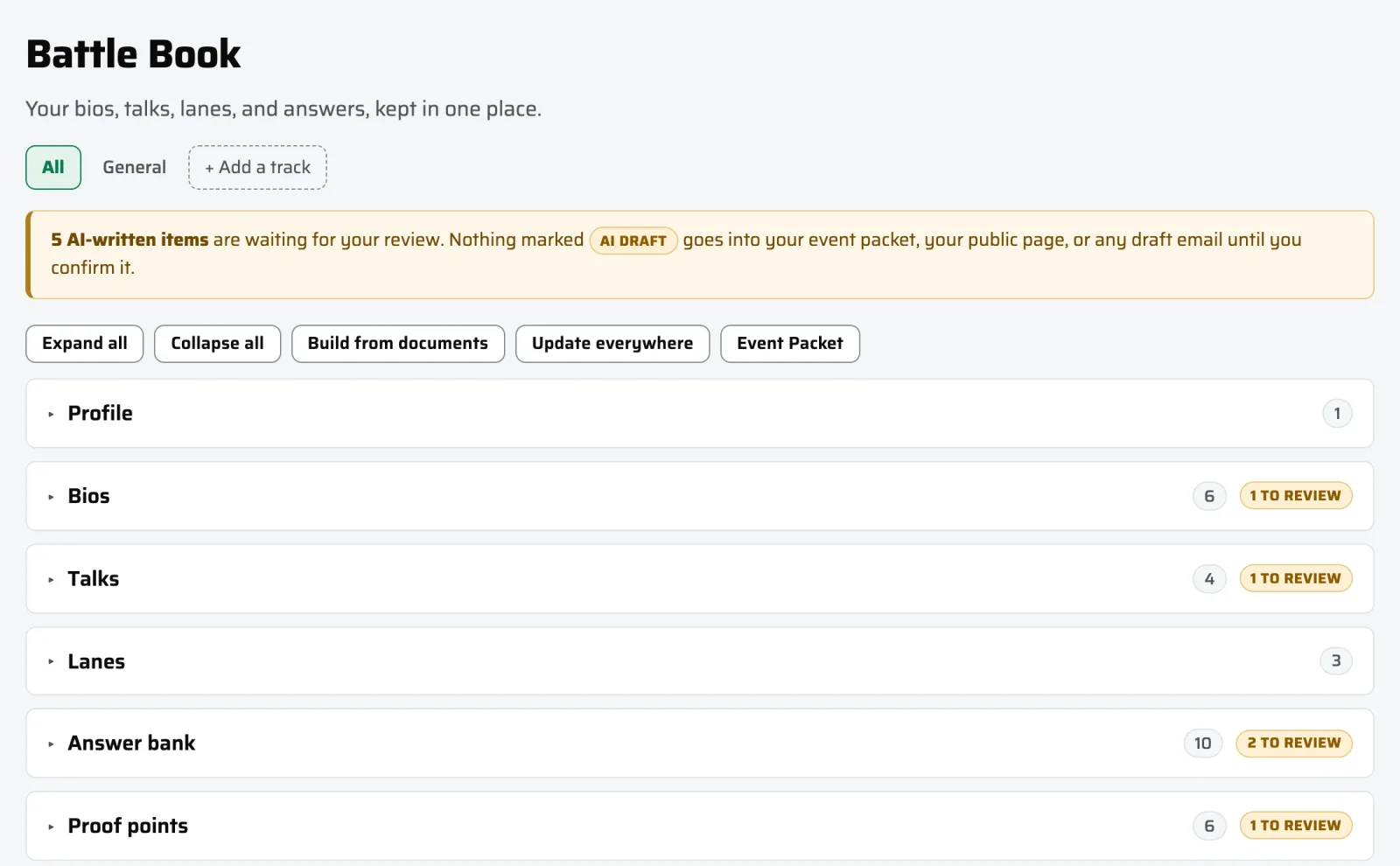
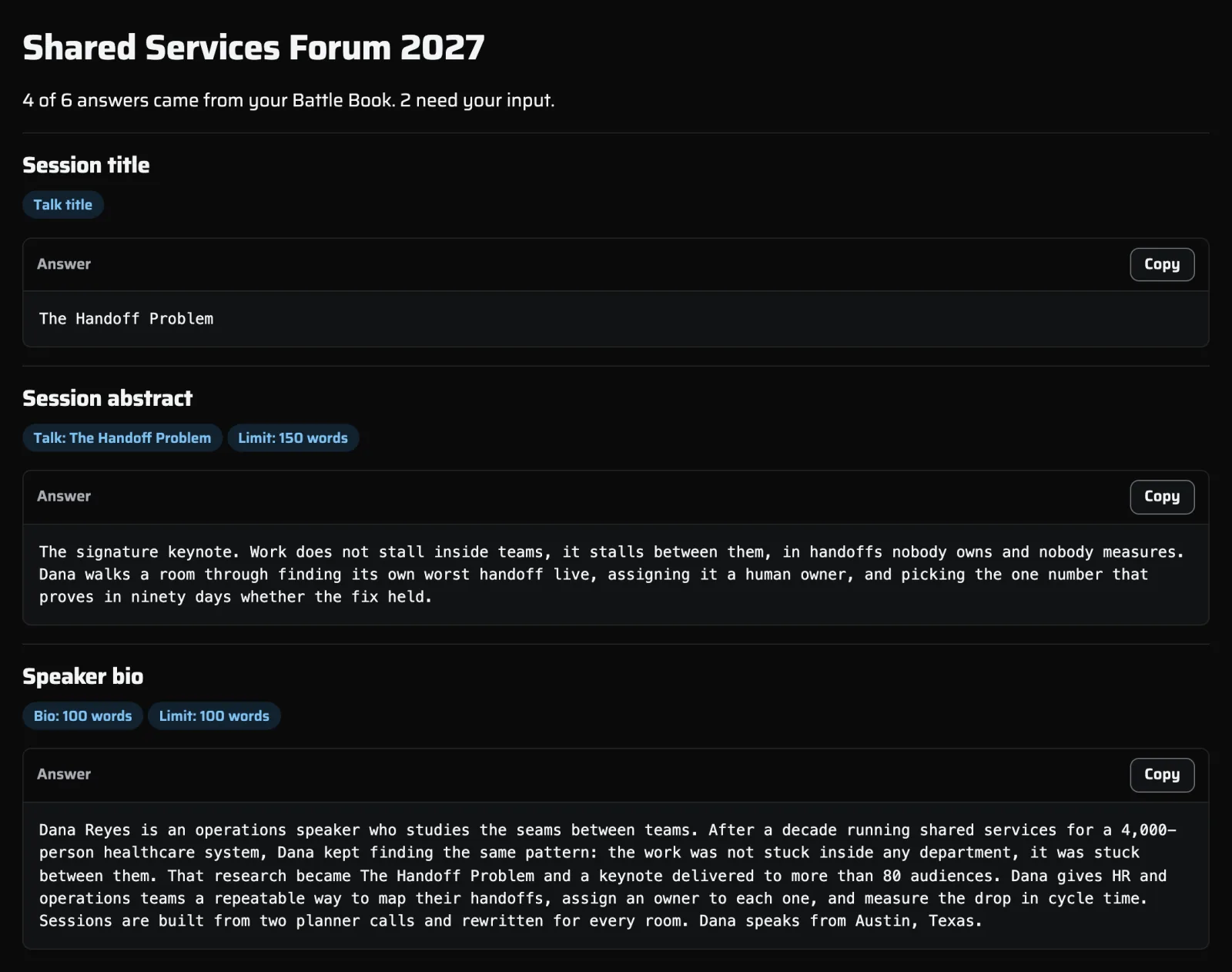
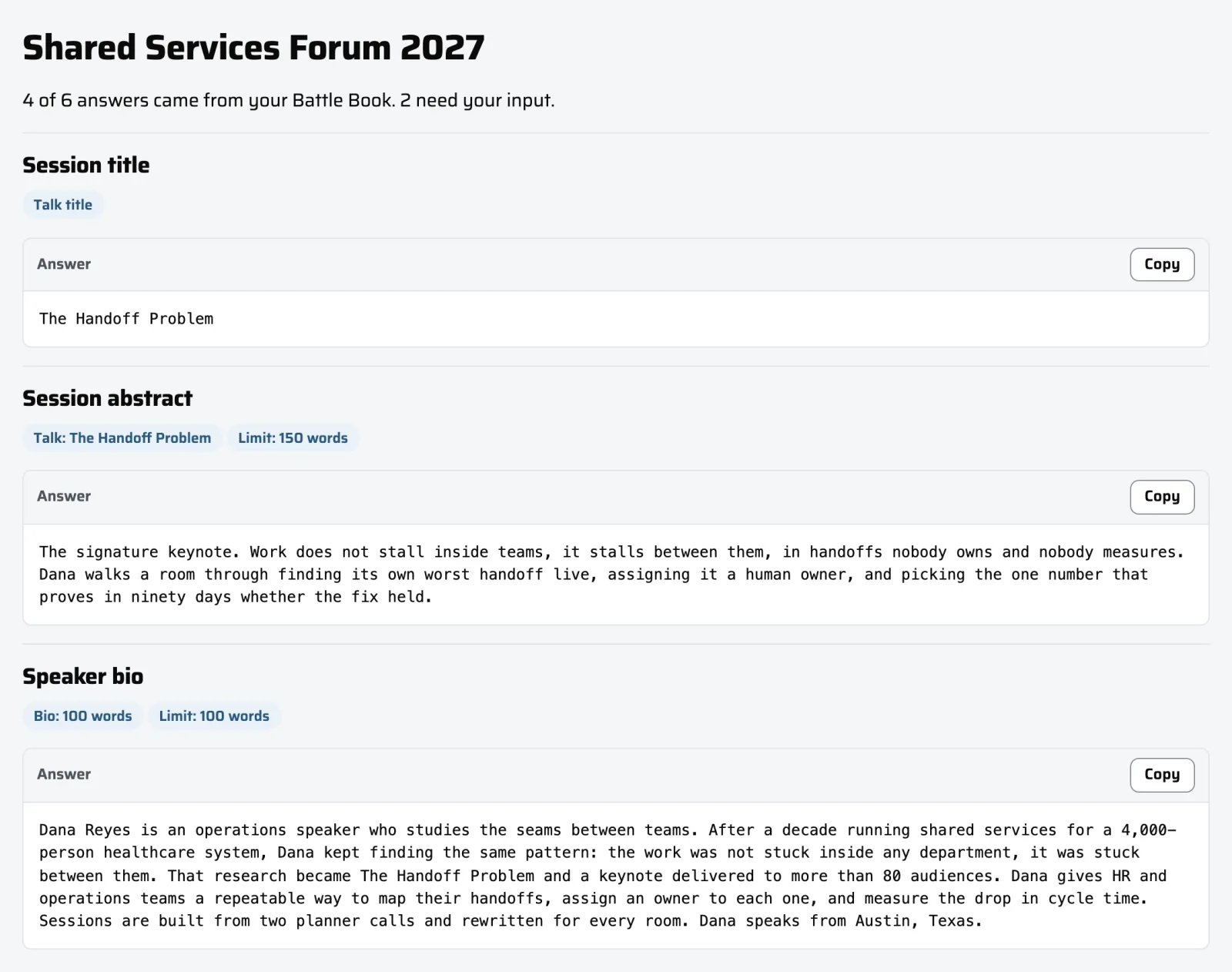
Fill in your Battle Book one time and every application after that is assembly instead of authorship. Bios at five lengths, plus the one-liner. Your talks, with takeaways and formats. An answer bank for the questions that keep coming back. Proof points, past engagements, testimonials, headshot and reel links.
More applications out the door
The part that used to take an afternoon takes minutes, so the number you send in a season goes up rather than the hours you spend.
Nothing found out too late
Deadlines sit on your Tracker with the rest of the pipeline, flagged at seven days and two days, while you can still do something about them.
Worth more every year
Deliver an event or turn one down and it comes back ten months later as a fresh suggestion, dates moved forward a year. Year two beats year one.
Nothing goes out under your name unless you send it
The first two are written into the code, not into a settings screen you have to find. The third is how the drafting works.
You send your own email
Concierge writes the pitch and hands it to you. You paste it into your own mail, change what you want, and press send yourself. Every word an organizer reads is a word you chose.
You submit your own applications
Speaker Radar assembles the answers and you paste them into the form. That one extra step is the reason nothing embarrassing ever reaches an event in your name.
You have full control of your voice
Every draft is built from words you already wrote: your bios, your talks, your answer bank. Nothing is invented to fill a box, anything drafted for you is marked until you confirm it, and you can rewrite any of it. It sounds like you because it came from you.
Built by a speaker who runs his own bookings on it
Jeff Arnold speaks to HR and legal audiences. His speaking business ran the way most of them run: a bio in four versions across four documents, a headshot somewhere in Dropbox, a one-sheet somebody designed in 2023, and a list of conferences he meant to apply to and never did.
He runs 4Spot Consulting, an automation firm, so he built the thing that fixes it. Then he kept using it. His bios, his talks, the two audiences he speaks to, and the events he is chasing this season all live in Speaker Radar, and the demo runs on that same Battle Book. The product you sign up for is the one he uses on Monday morning.
It is as easy as 1-2-3
-
Upload what you already wrote
Bios, your one-sheet, past applications, your About page. Speaker Radar reads them and hands back a first-draft Battle Book to correct, rather than a blank form to fill in.
-
Name the stages you want
A lane is a topic and an audience. Lanes are what the Matcher scores new opportunities against, so this is the step that decides what shows up for you.
-
Apply, and let the Tracker manage the rest
Paste an application’s questions in, get finished answers back, send it, and move it along the pipeline. The follow-up, the deadlines, and next year are handled.
We know you want to be on more stages
At Speaker Radar we know you want to be on more of the right stages. To do that you need a steady supply of events worth applying to and a fast way to apply. The problem is that finding them takes a weekend and applying takes an afternoon, which makes you feel like the business side is eating the part of this you actually love.
We believe a speaker's time belongs on the talk and the stage, not on hunting for conference websites and retyping a 150-word bio for the ninth time. So we do the searching, and we built the booking desk: one place for everything an application asks for, and a pipeline that remembers what you did last year.
Sign up and load your Battle Book. In the meantime, read how the whole loop works.
Start with the material you already have
Seven days of Concierge, free, no card required. Upload what you have written about yourself and watch your own Battle Book fill in. After that you keep a free account for good.